
SeniorMedRides.com Research
Research & Insights · Foundations series, No. 3 of 3
Research & Insights
How We Measure Senior Transportation Access
Understanding transportation challenges among older adults requires more than counting people, vehicles, or transportation providers. Reliable research begins with knowing what the available data can—and cannot—tell us.

How many older adults have difficulty getting to medical appointments? Which communities face the greatest transportation challenges? Where are accessible transportation services most needed? These questions are important—and harder to answer than they first appear.
A community may have thousands of older adults who experience walking difficulty. Another may have many households without vehicles. A third may have few publicly identified transportation providers. None of these observations, by itself, establishes how many people cannot obtain transportation.
At SeniorMedRides, our approach begins with a principle: measure what the data supports, explain what it does not measure, and distinguish established findings from questions requiring further investigation.
Start With the Population
The U.S. Census Bureau’s American Community Survey (ACS) provides demographic, housing, and disability-related information. Two measures are particularly relevant: serious difficulty walking or climbing stairs, and household vehicle availability.
Together, these can help researchers examine the intersection of mobility limitations and household transportation resources. Neither directly establishes whether someone needs a ride. An older adult with serious walking difficulty may have reliable transportation; someone without a household vehicle may use public transit or family assistance.
Why Combining Data Requires Care
Published ACS tables can describe serious walking difficulty among older adults in a county. Other tables can describe households with no vehicle. These measures may use different populations and statistical units: one counts people, the other households.
We cannot simply multiply the two percentages and claim to know how many older adults experience both conditions. To examine the intersection directly, researchers can use appropriate individual-level survey records. The ACS Public Use Microdata Sample (PUMS) supports certain analyses while protecting respondent confidentiality.
Understanding Geographic Boundaries
A city, county, metropolitan area, and Census Public Use Microdata Area are not interchangeable. A transportation provider may serve several counties; a transit agency may operate within only part of a metro region; and Census geography may include communities beyond a city’s commonly understood boundaries.
SeniorMedRides uses explicitly defined study geographies. They do not necessarily represent official metropolitan statistical areas or actual transportation-provider service territories. Readers should know which communities are included before comparing figures.
Why Survey Estimates Include Uncertainty
The ACS uses population samples and statistical weighting rather than counting every resident. Estimates therefore have uncertainty, often expressed as a margin of error. The ACS commonly reports 90% margins of error.
When comparing communities, a higher estimated percentage may not be statistically distinguishable from another once sampling uncertainty is considered. Responsible research avoids declaring a place the highest or worst based on a small difference between estimates.
The Difference Between Transportation Barriers and Unmet Need
Four questions require different evidence:
- Who may face transportation challenges? Demographic and disability data help describe relevant characteristics.
- What transportation services are available? Provider and transit records may help.
- Can people actually use those services? That requires information about accessibility, eligibility, coverage, hours, cost, and assistance.
- Which trips are not completed? That may require surveys, program records, or other direct evidence.
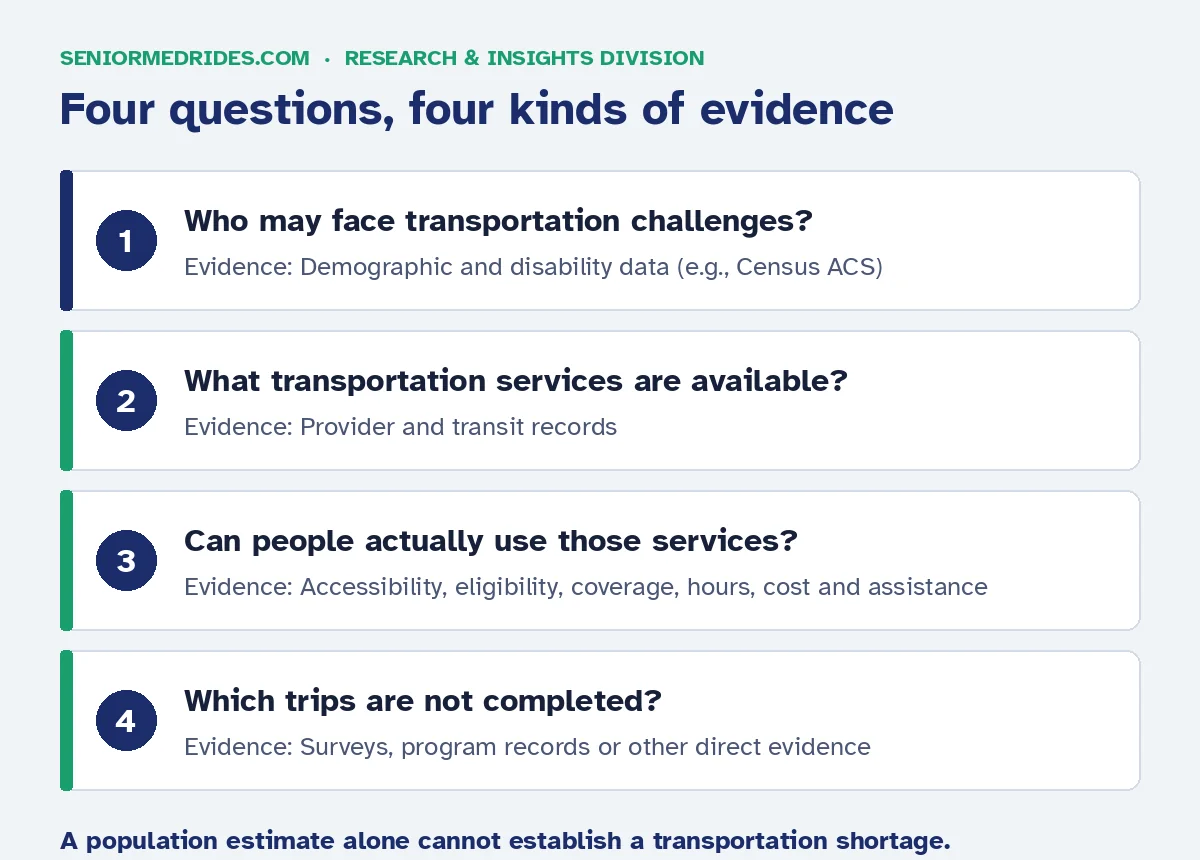
A population estimate cannot establish a transportation shortage on its own. Likewise, a list of transportation providers cannot establish that sufficient service exists.
What Provider Directories Can—and Cannot—Tell Us
Directories help identify possible services, but a listing does not necessarily show that a provider is operating, accepting passengers, or offering a specific service today. A wheelchair-accessible provider may have a limited service area; another may primarily serve contracted clients.
Research should distinguish directory records, independently corroborated information, and directly verified service capabilities. (For how the SeniorMedRides directory labels its own listings, see how listings are checked.)
Why Reproducibility Matters
Good research should allow another qualified analyst to understand how findings were produced. This means documenting data sources, geography, calculations, assumptions, and statistical methods. Where practical, supporting datasets, dictionaries, and code should be available. Independent validation provides another layer of confidence. Reproducibility does not mean every question has been answered; it means the reported findings can be examined and tested.
Our Eight-Area Research Initiative
SeniorMedRides is developing the Senior Transportation Access Report, analyzing older-adult mobility characteristics and household vehicle availability across study areas associated with Phoenix, Tampa, Orlando, Boise, Sacramento, Stockton, Salt Lake City, and Las Vegas.
The study uses 2020–2024 ACS data, including public-use microdata, to examine the relationship between serious walking difficulty and living in households without vehicles. It is designed to describe measurable characteristics, compare study areas where statistically appropriate, and provide a foundation for future research. It is not intended to estimate the number of people requiring non-emergency medical transportation or the number of unfulfilled trips. The report, methodology, data, and local fact sheets remain subject to final publication approval.
What Better Research Can Make Possible
Well-documented findings help community organizations ask better questions, transportation planners identify areas for further investigation, and healthcare organizations understand characteristics of the populations they serve. Combining demographic research with independently corroborated transportation-service information may eventually offer a fuller picture of local access.
Better Information Leads to Better Questions
No single dataset explains the entire transportation experience of older adults. Population statistics cannot tell us every person’s needs; provider directories cannot guarantee service availability; and geographic comparisons cannot capture every circumstance.
The purpose of responsible research is not to make the strongest possible claim. It is to make the strongest claim the evidence can support.
Find a ride. SeniorMedRides lists non-emergency medical transportation providers, paratransit and volunteer driver programs in these cities:
Citing this article
SeniorMedRides.com, “How We Measure Senior Transportation Access,” November 2026, https://seniormedrides.com/research/how-we-measure-senior-transportation-access/
Sources and Further Reading
Related research. Census-based findings for eight U.S. study areas are in the Senior Transportation Access Report, Version 1.0, with a fact sheet for each study area.
Medical emergency? Call 911. This article is general information, not medical, legal or insurance advice.